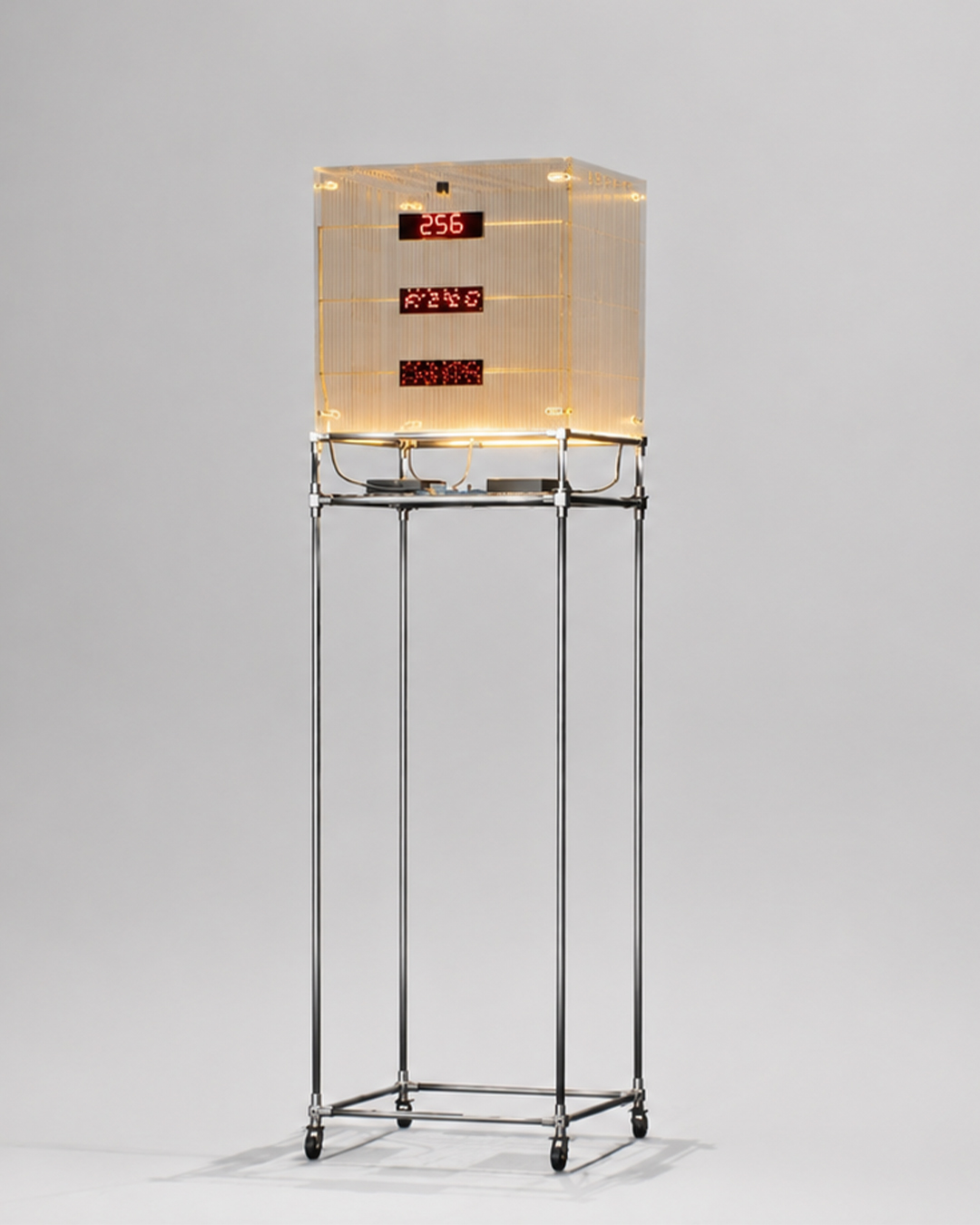
Witness Node
Witness Node is a sculpture that acts as an entity, guiding you through a divination process as a ritual experience. We live in a moment where technology accelerates faster than our ability to question it, where algorithmic systems shape reality while indigenous knowledge is still framed as primitive, folklore, or pre-scientific. This work proposes a different lens: what if we discerned more carefully the current stages in the developmental process of technological knowledge? What if, like the Sankofa principle in Akan culture, we returned to the past not to remain there, but to fetch what we need to move forward?
It is grounded in research into ancient spiritual technologies, particularly the Opele chain and the mechanics of Ifá divination in Yoruba tradition, and Afa, the Eʋe expression of Ifá, practiced across West Africa and diasporic communities worldwide. Both traditions are rooted in a complex binary-based system that is also the foundational language of computing. Niels Bohr recognised binary complementarity as foundational to quantum mechanics. It stands as one of humanity’s most significant intellectual contributions.
The divination unfolds in three states. First, the sculpture acknowledges your presence; it counts you, and speaks: your soul is witnessed. You become part of a collective memory, a living pool of every person who has passed through. The system then enters a processing state, where an algorithm generates a seed number shaped by the time of day, the count of visitors before you, the previous seed, and layers of controlled randomness. Finally, it reaches revelation. Your seed, a number between 0 and 255, is split into an 8-bit binary value and translated across four LED modules on the middle screen, each displaying one of four symbolic states, producing one of 256 unique patterns that mirror the 256 Odu of Afa. One number, unfolded into four binary symbols: a compact fingerprint of your moment of presence. The sculpture then speaks. A voice delivers a message for your path.
This correspondence is not metaphorical. The Ifa literary corpus organises into 16 books with 256 chapters, and 256 is precisely the number of unique values encodable in 8 binary digits, the foundational unit of modern computing. Each of the 256 Odu Ifa signatures maps directly to each of the 256 ASCII characters on a computer keyboard. The structure was always there.
Witness Node challenges the dominant narrative that positions Western science as the origin of sophisticated thought. It opens space for counter-narratives, an invitation to stop seeing indigenous knowledge as a precursor to something else, and to recognise it as advanced, complete, and foundational to what we call modern technology. Data transmission as energy exchange. Algorithms as oracles. Technology as ritual companion. Not speculative futures. Ancient practices waiting to be acknowledged.


